
Deleting 60% of My Website Was the Best SEO Decision I Made
This is a walkthrough of what I've been doing with SEO at my agency — trying to actually rank for the keywords we care about around Klaviyo and email marketing — what the experience has been like, and the wins I've had so far.
Spoiler: the single biggest lever was deleting most of my website.
Where Things Started: Terrible
When I look at the last 16 months of Google Search Console, the picture a year ago was grim. Barely any impressions. An average position hovering around 50. Almost no clicks.
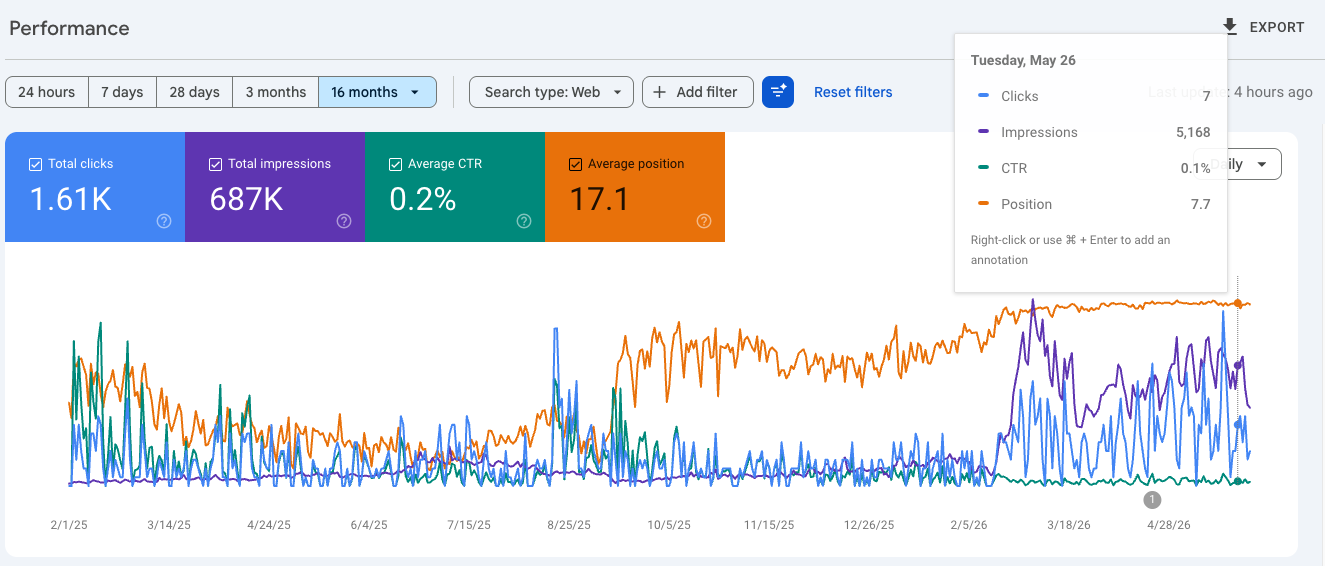
That chart tells the whole story: flat and miserable through most of 2025, then clicks and impressions taking off in early 2026 while the position line kept climbing. The 17.1 you see up top is the 16-month average — today we're sitting at a current position of 7.7. Here's how that happened.
It wasn't a priority back then, and it showed. I had an old business partner who'd worked with a content mill — a ton of AI-written, super-templated, super-generic garbage just dumped onto the site. We'd been hit hard for it. In Ahrefs you could see it plainly: tons of pages, no traffic, and a URL rating that was actually going down.
It just wasn't working. I knew we had to do something.
Fix #1: Getting Off Webflow
At the time we were on Webflow, which I hate. It is the worst.
The first big jump in our average position lines up exactly with the moment I moved us off it. You can see it in the chart below: right around September 2025, the orange position line spikes up out of nowhere. I'm not enough of an expert to tell you precisely why — something about how Webflow was organizing all of our content — but that switch alone took us from an average position around 50 to the low 20s.
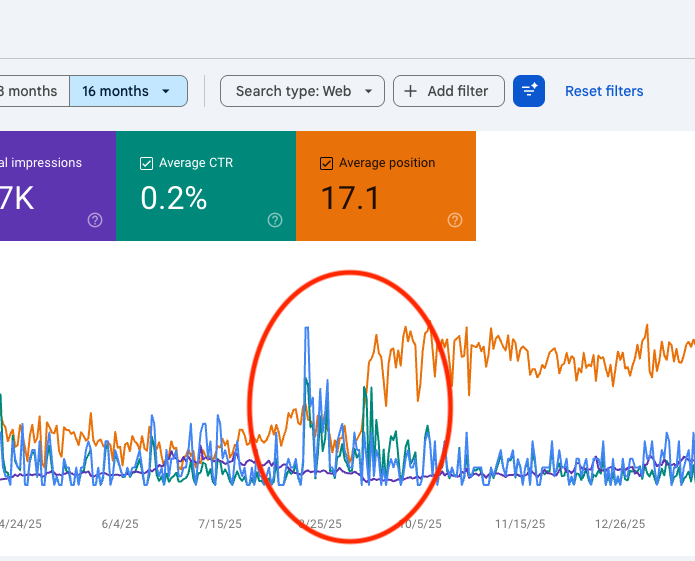
That was the biggest single move. After that we hung out in the 20s for a while, and I started paying real attention: which keywords did we actually need to target, and how should we be organizing our on-page SEO?
Fix #2: Deleting 60% of the Site
Then, right around February 2026, everything exploded. Positions climbed toward 10. Clicks jumped. Impressions jumped. We finally started showing up.
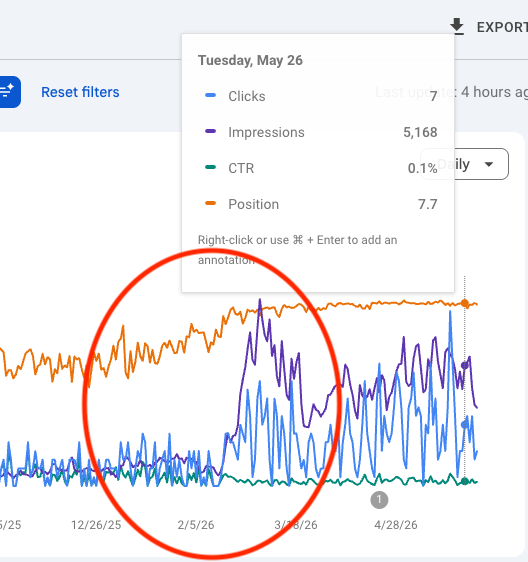
So what changed? At that exact moment, there's a massive drop in one line: crawled pages. We went from 385 pages down to around 140. You can see the cliff here — the dark line falls off while organic traffic (the orange line) climbs right behind it.
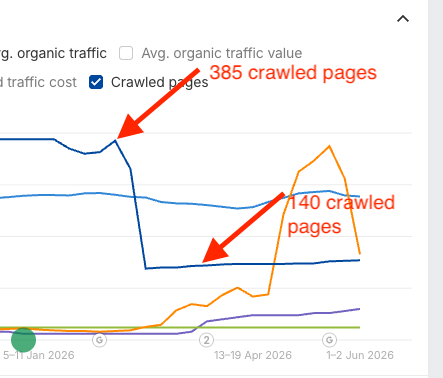
That was deliberate. It was a concerted effort to get rid of all the old crap clogging up the site. For anything that had started to rank, I rewrote it into something real — something actually valuable. Everything else I mostly redirected rather than deleted, because there was so much overlap between the old articles. I'd take the ones that were outdated, not ranking, or just generally garbage, and point them toward the pages that actually mattered.
Cutting that dead weight is what really started to help.
Fix #3: Publishing Things Only I Can Write
While I was rewriting old content, I also started publishing new content — consistently, starting around that same February mark.
The key wasn't volume for its own sake. It was writing unique things: lessons I've actually learned, insights only I have based on the work we've done, aggregating things you won't find spelled out anywhere else. That's what started to pay off. Google indexed a bunch of it, so impressions and clicks dipped for a stretch, but our position kept climbing — that steady upward trajectory.
The Free Tools Experiment
The other thing I built was a set of free tools on the site. Transparently, they don't get much traffic and they don't convert well. But people do come back and use certain ones, they get indexed, and they work as a little show of expertise. Worth it as an experiment.
What It's Actually Led To
Here's the honest part. This has been roughly a six-month journey, and so far it's generated exactly one call for my agency.
A lot of work for one call. But this was never the kind of channel you switch on and judge the next day, like ads or cold outreach. SEO is a long-term, compounding play. The whole point is that the work I did to set us up keeps paying off.
So now I've taken my foot off the brake a bit. The heavy lifting is done. I'm focused on staying consistent — one to four posts a month — and the next step is exactly what you're looking at: starting a YouTube channel, making videos on the topics I've already written about, plus other things I find interesting and relevant. The bet is that the writing and the video compound together over the long haul.
I'm by no means an expert. I've hacked my way to where I am, leaning on AI as much as I can and just trying to stay consistent. But if you're sitting there wondering where to start or what kind of results to expect — this is what it's looked like for me.